MADEBACK Festival

Rethinking fashion through what already exists

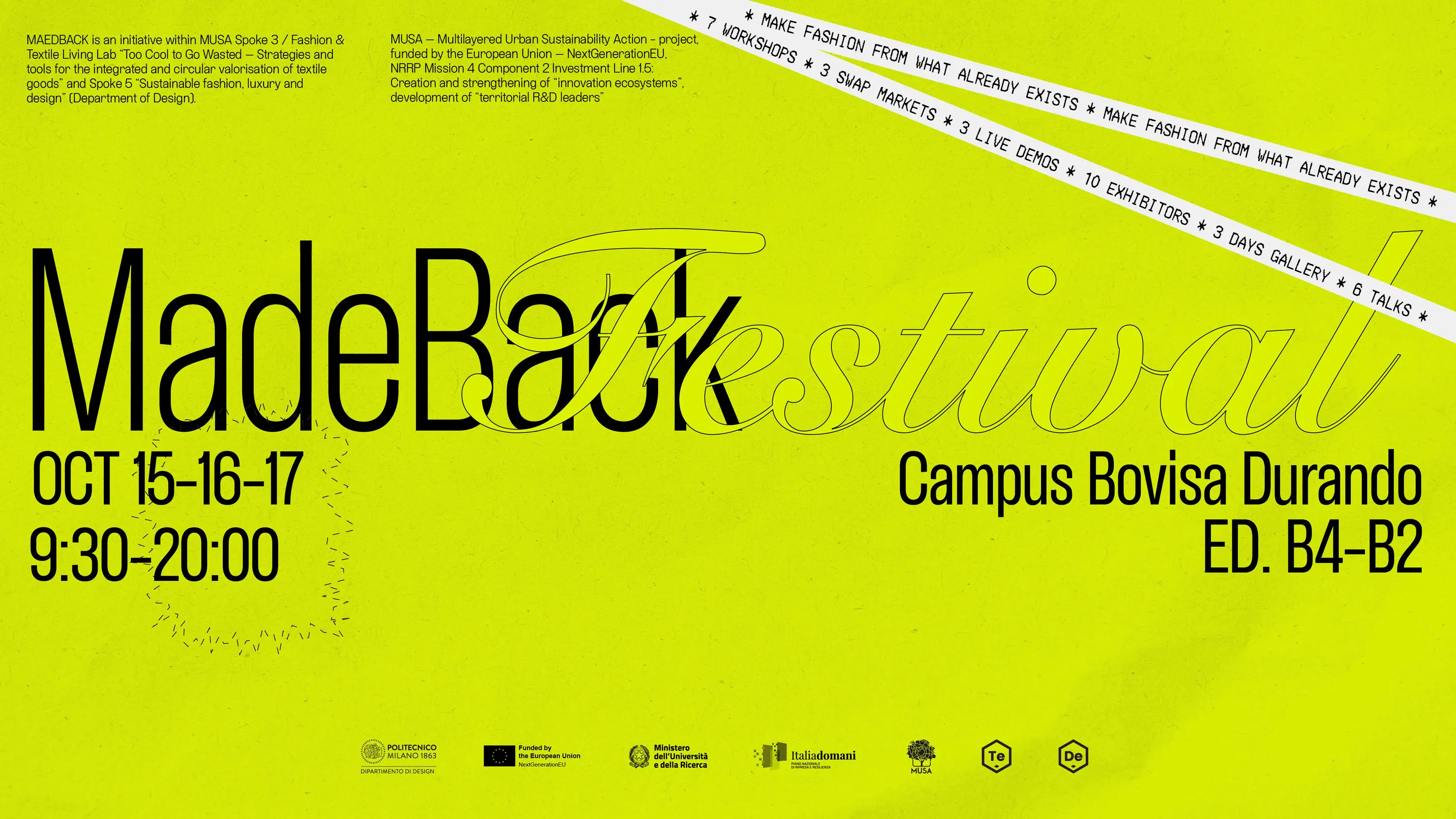
The image is a visually striking graphic poster set against a vibrant lime-yellow background, promoting the "MadeBack Festival." The design features modern, dynamic typography, layering the main title over informative text regarding dates (October 15-16-17), times, and the location at Politecnico di Milano's Campus Bovisa Durando. The poster lists various activities such as workshops, swap markets, and talks, emphasizing the theme of circular economy in fashion with the slogan "Make fashion from what already exists," rounded off by institutional logos of partners and funders at the bottom.

From October 15 to 17, 2025, the Bovisa Durando Campus of Politecnico di Milano will host MADEBACK, the first festival dedicated to circular fashion. The event is organized by the Department of Design as part of the Fashion & Textile Living Lab “Too Cool to Go Wasted”.

The Festival marks the official opening of the Living Lab’s new space and is part of the initiatives promoted by the PNRR MUSA project – Multilayered Urban Sustainability Action (Spoke 3 and Spoke 5).

MADEBACK was created with the aim of going beyond the linear production paradigm—based on the continuous use of new resources—to promote an alternative vision: the "made-back," a rethinking of making that starts from what already exists. The Festival activates a system of collection, transformation, and restitution of used garments, experimenting with replicable circular models that combine design, practice, and community engagement.
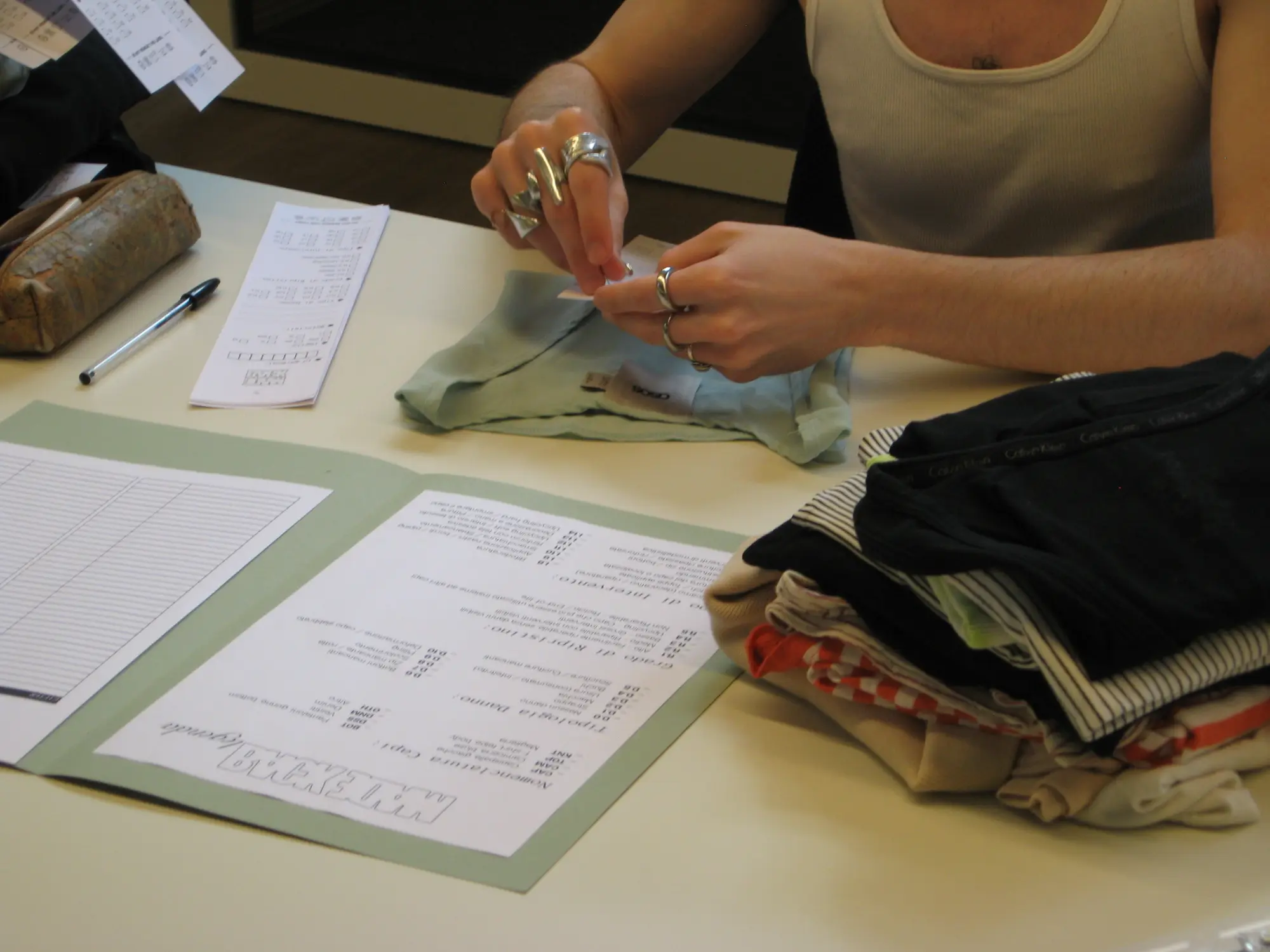
A person is seated at a table carefully examining or labeling clothing items, in what appears to be a cataloging or quality control process. On the workspace, a stack of folded clothes is visible alongside technical forms filled out in Italian featuring sections like "Garment Nomenclature" and "Type of Damage," as well as pens and cases, suggesting a professional or academic setting related to textile management and sustainable fashion.

For three days, the Campus opens its doors to the public and hosts a diverse range of designers, artisans, and local services, with the goal of fostering knowledge exchange and activating new collaborative networks. The program is structured around various thematic and operational areas:

7 workshops – three of which precede the festival as moments to engage and activate the community, and four that take place during the event itself – focused on transforming garments collected through two internal collections within the Politecnico community;

3 live demos by artisans and designers, showcasing techniques for repair, regeneration, and customization in real time;

Exhibition gallery with 10 stations, divided into four thematic areas: Reduce, Repair, Upcycling, End-of-Life, presenting materials, processes, and design visions;

Swap Market, where second-hand garments—regenerated or redesigned by workshop participants—are exchanged in an informal and accessible setting;

Daily talks that bring together academia, professionals, and public and private stakeholders, to delve into the festival’s core themes.

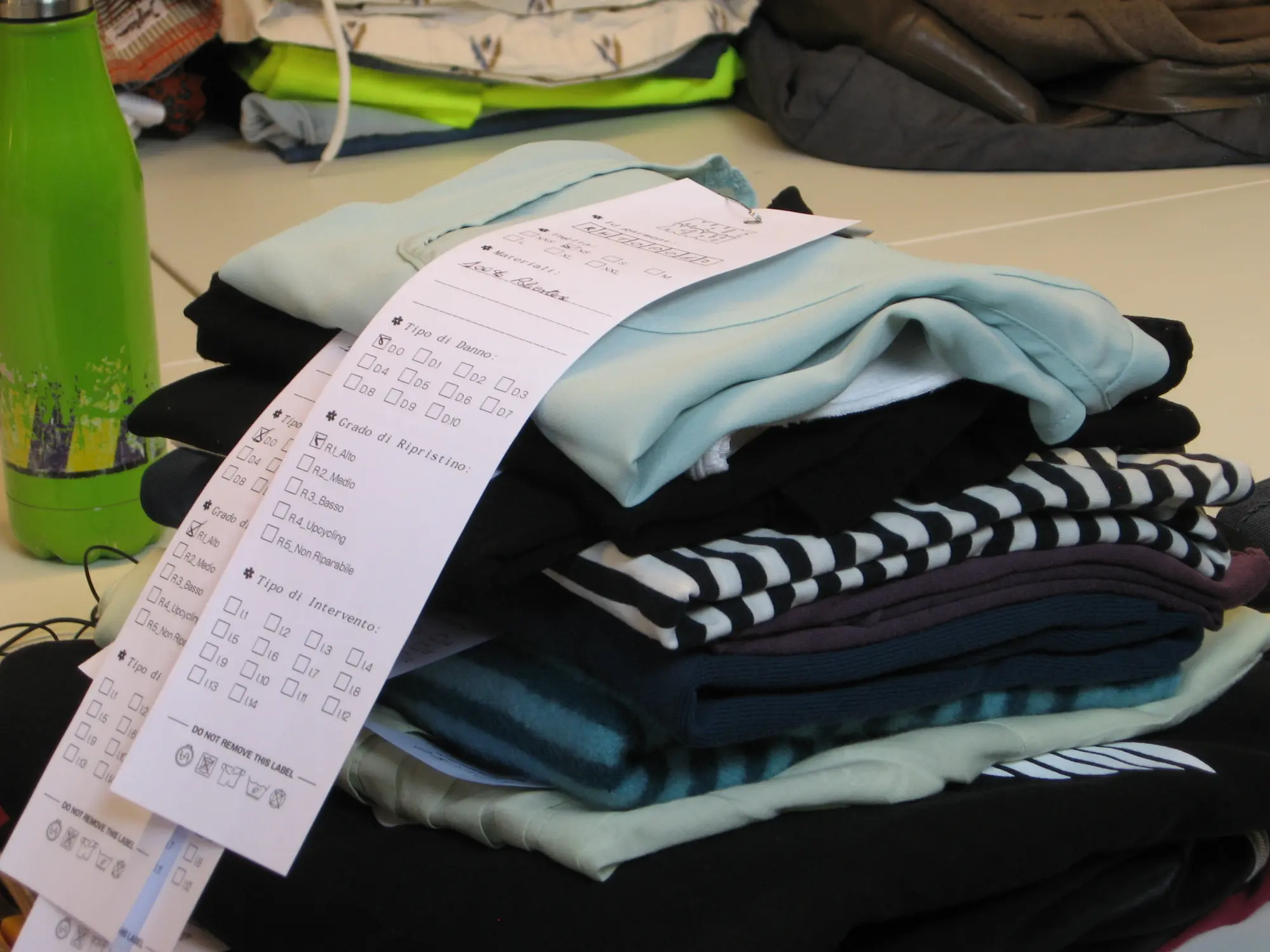
A stack of folded garments is at the center of a cataloging and assessment process for reuse or recycling. Detailed technical tags in Italian are attached to the fabrics, featuring classifications such as "Type of Damage," "Restoration Grade," and "Type of Intervention," highlighting a systematic and professional approach to sustainable fashion and circular textile management.
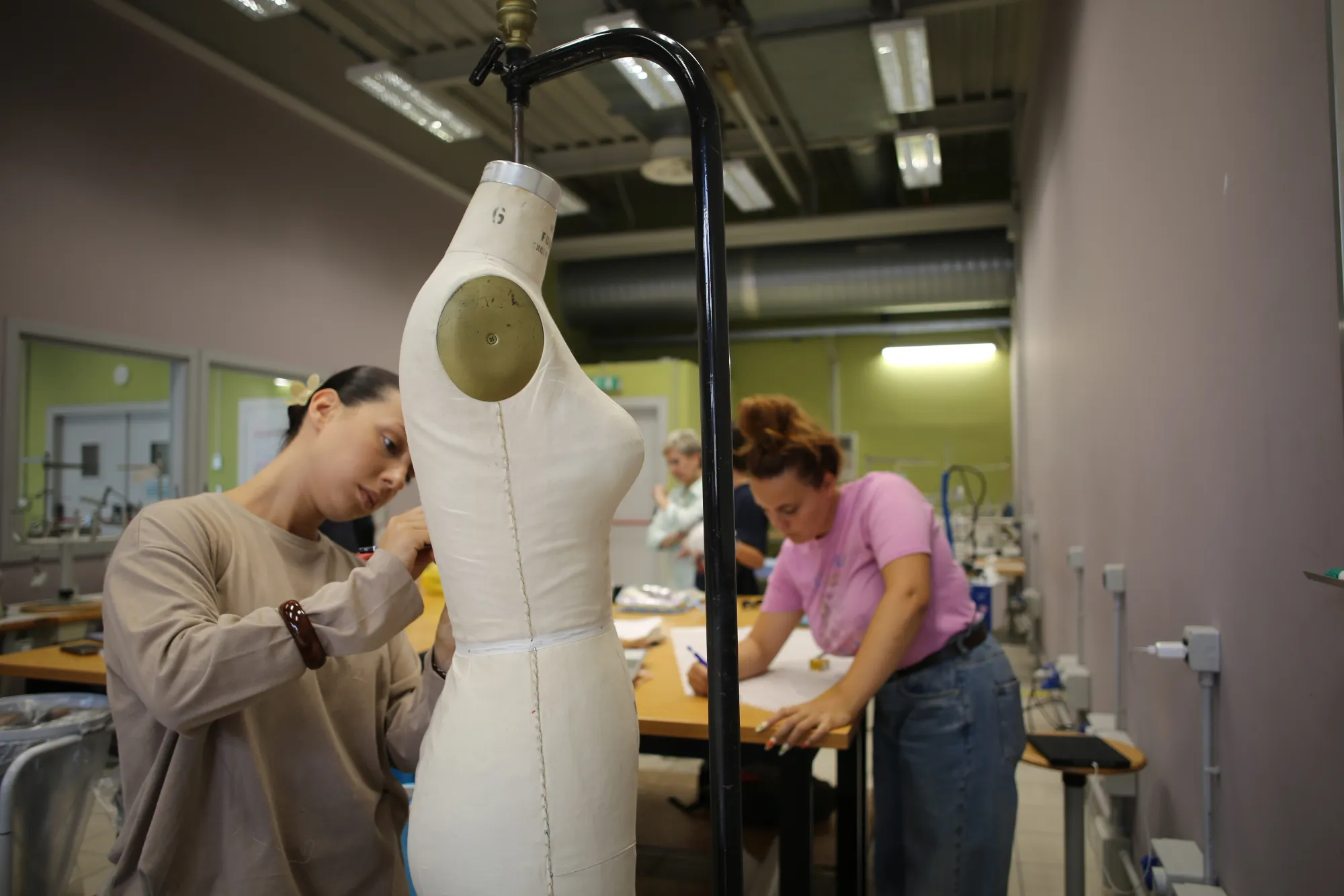
In a fashion workshop, a young woman works with precision on a dress form, while in the background, another person is busy drawing garment patterns on a workbench. The setting suggests an educational or professional environment dedicated to fashion design and garment creation, where attention to detail and the study of forms are essential for developing new textile designs.

MADEBACK presents itself as a collective moment of reflection, dialogue, and inspiration, aiming to generate lasting impact on the local territory. The goal is not merely to add value to the product, but to refocus on making itself: a cultural and operational process based on shared, transformative practices capable of shaping new sustainability models for the textile sector.

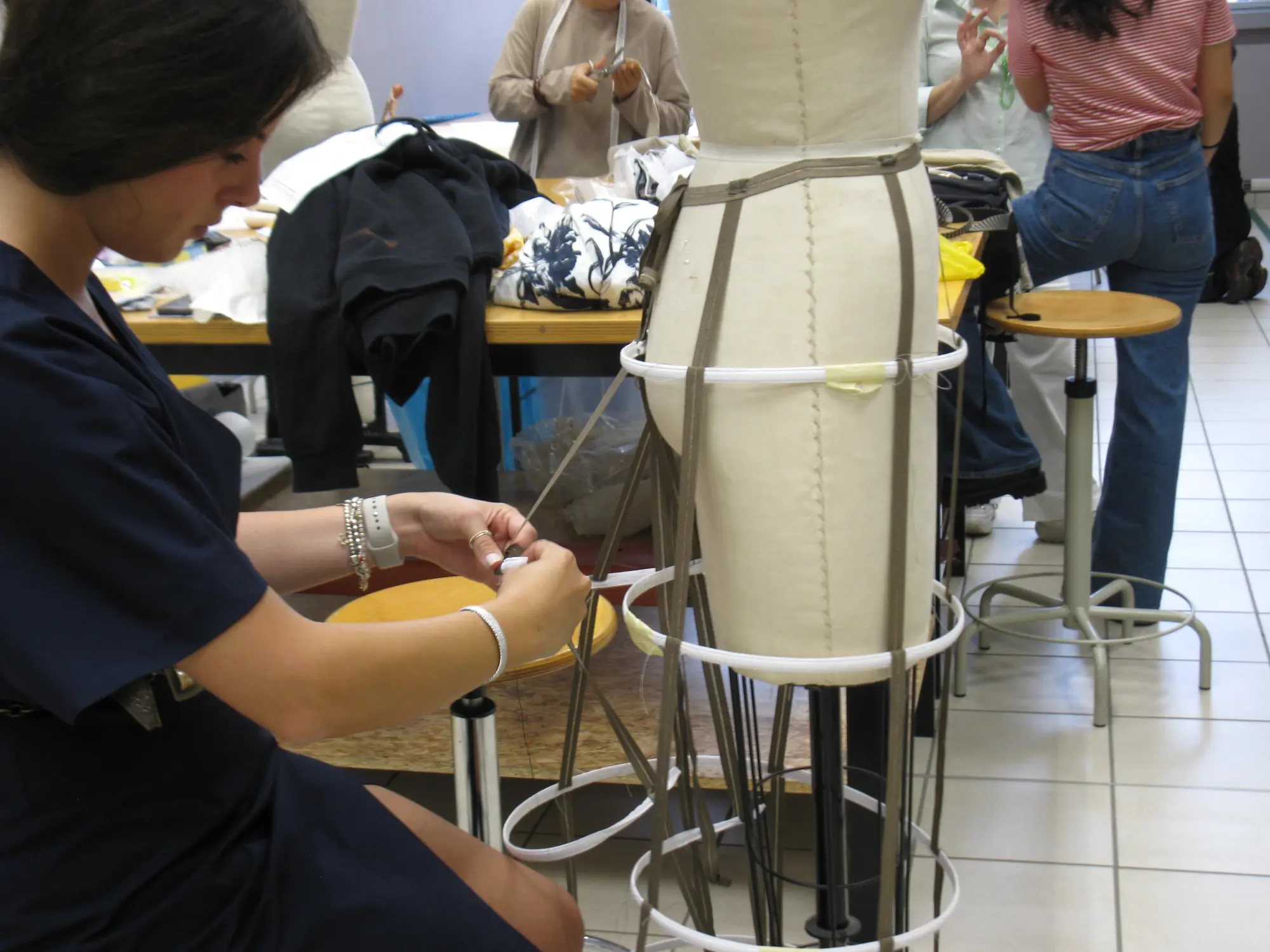
In a fashion workshop, a student carefully works on a garment structure, attaching ribbons and shaped hoops to a dress form to define its volume and silhouette. In the background, other people are engaged in various sewing and cutting activities at worktables, creating an image that depicts the technical and creative stages of high-fashion design within an academic setting.
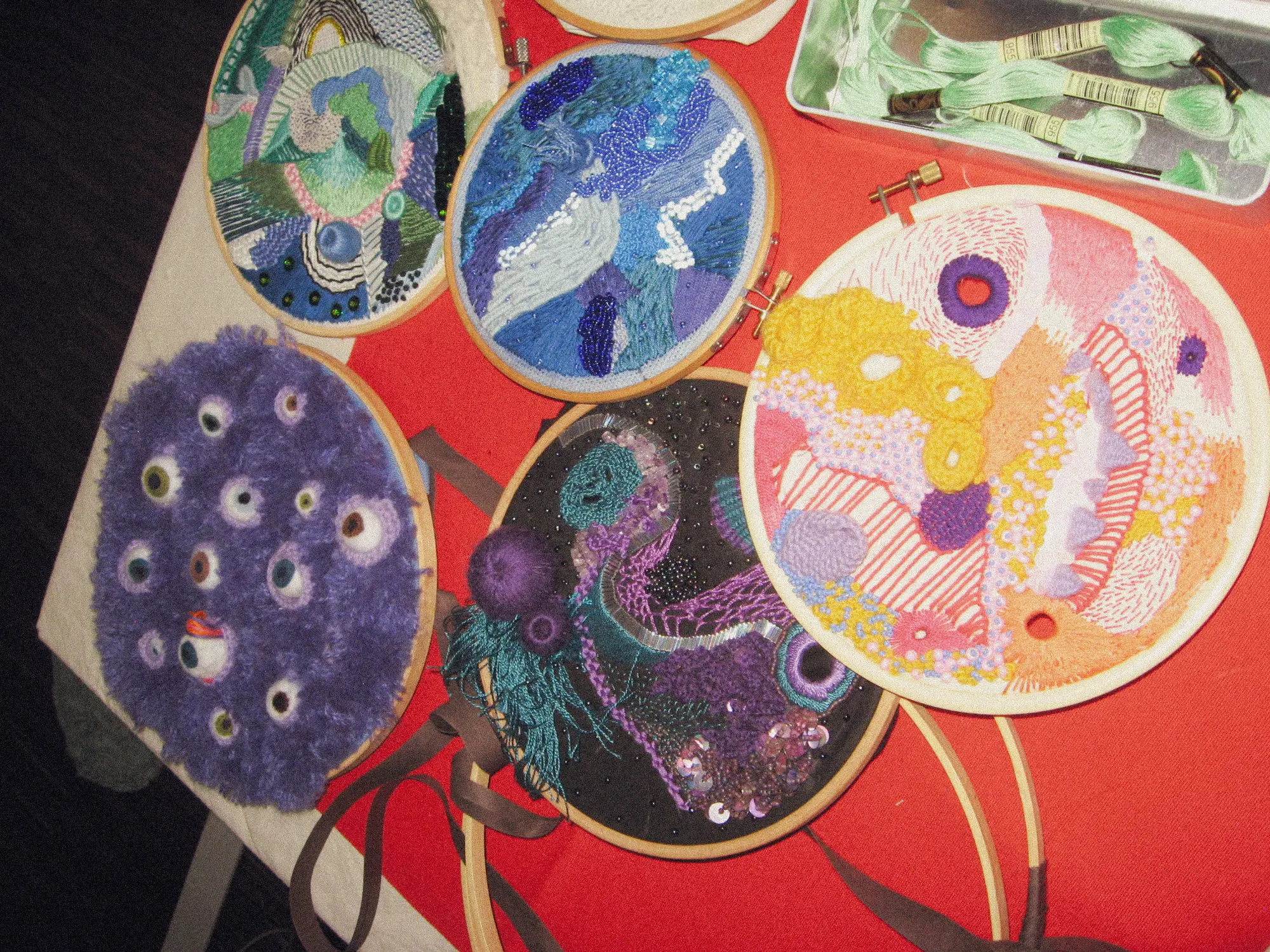
A series of circular embroidery hoops is arranged on a red surface, showcasing various textile artworks rich in detail and texture. Each embroidery features a unique style, combining colorful threads, beads, sequins, and 3D inserts to create abstract compositions or imaginative figures ranging from cool blue and purple tones to warm shades of yellow and pink. Next to the hoops, a box containing skeins of green thread is visible, suggesting an ongoing craft project that celebrates creativity and manual skill.

For all updates, follow MADEBACK's Instagram profile: madeback_fest

Share on: