
Designing Hybrid Spaces

Edited by Laura Galluzzo and Salvatore Di Dio

The image is an abstract graphic background featuring a dark purple/indigo gradient. The composition includes minimalist blurred geometric shapes, with two circular forms on the left and a stylized star in the bottom right. The style is clean and professional, consistent with the visual identity of the background series shown earlier.

This volume investigates the potential of Socio-Cultural Hybrid Spaces as engines of urban regeneration, democratic participation, and cultural innovation.

Designing Hybrid Spaces edited by Laura Galluzzo and Salvatore Di Dio was published by FrancoAngeli.

The book develops a critical and impactful perspective on the functions, design and interdisciplinary approaches, and transformative potential of Socio-Cultural Hybrid Spaces. Emerging at the intersection of cultural production, social experimentation, and territorial transformation, these spaces challenge conventional boundaries between public and private, temporary and permanent, physical and digital.
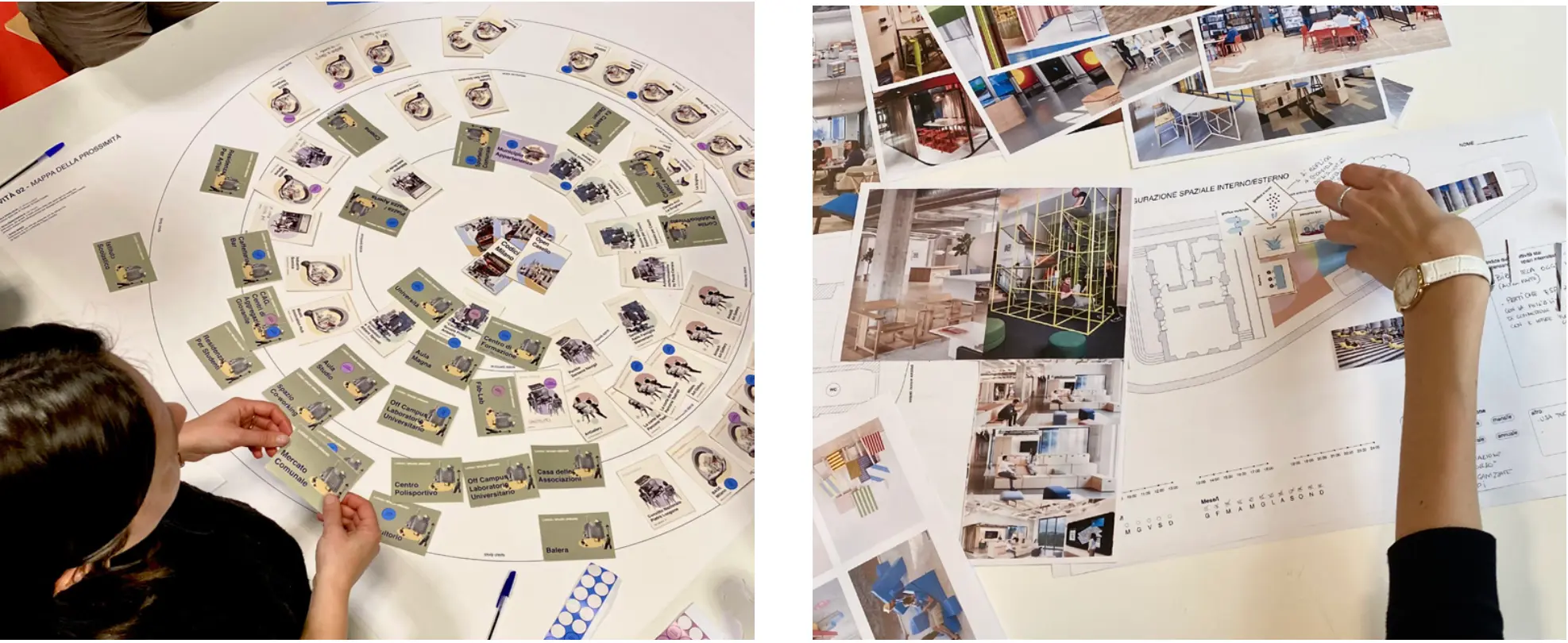
The image documents two moments of a co-design workshop dedicated to service and spatial design. On the left, a participant uses a circular mapping tool called "Mappa della Prossimità" to organize various cards representing urban and social services, arranging them according to distance or relevance. On the right, another participant works on a spatial ideation board, pairing photographs of architectural and interior design references with floor plans and schedules to define the concept and temporal management of a project. Both activities demonstrate the use of visual and participatory methodologies to facilitate collaboration and the development of complex design solutions.
Workshop activities at Open Casello. Photos by author. Image taken from the essay 'Co-designing Socio-cultural Hybrid Spaces: methods and transformative practices' by Ambra Borin.

From their evolving role as plural ecosystems to their capacity to generate declinations of public value; from cultural and participatory practices that reclaim and reimagine the commons to the opportunities and challenges introduced by digital technologies; it offers a multifaceted lens on hybrid practices in contemporary urban and territorial contexts.

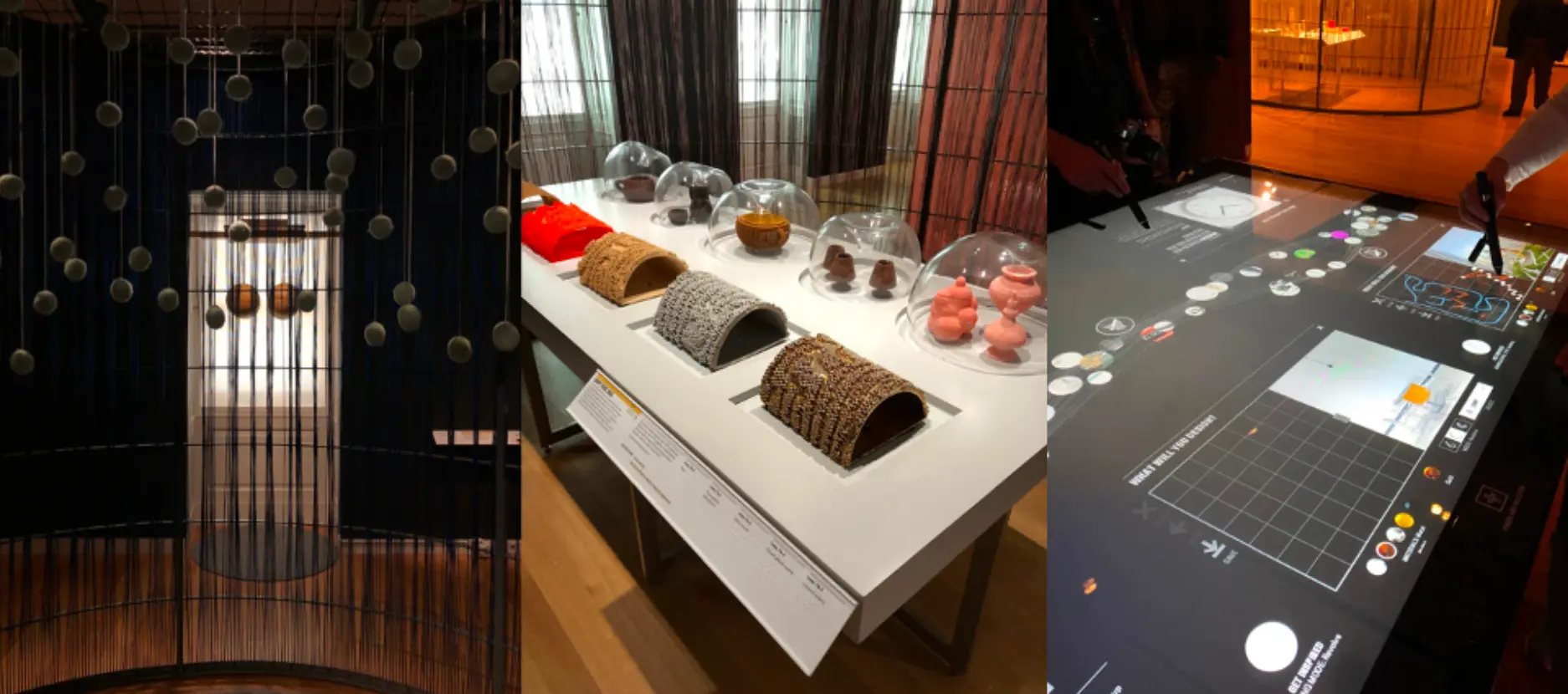
The image features a three-panel composition illustrating different dimensions of an exhibition dedicated to design innovation. On the left, an immersive installation in a dark setting shows suspended spherical elements floating among vertical strings, creating a play of light and shadow. In the center, a display table hosts curved material samples with various textures and objects protected by transparent hemispherical cases, highlighting experimental surface research. On the right, the digital interactivity section shows a visitor using a stylus on a large touch-table to engage with diagrams and co-design models. Overall, the scene describes an exhibition path that combines spatial perception, tactile material analysis, and active digital participation.
Multisensory interactions at The Senses: Design Beyond Vision exhibition (Cooper Hewitt, 2018), exploring touch, sound, and scent through integrated physical and digital experiences. Source: Authors (2018). Image taken from the essay 'Sensory design in phygital environments: expanding participation through embodied experience' by Paulo Eduardo Tonin, Marinella Ferrara and Elton Moura Nickel.

By weaving together theoretical perspectives, empirical research, and case studies, this book provides critical reflections by and for scholars, practitioners, and institutions. How can cultural initiatives generate new alliances between institutions and communities? What forms of participation can strengthen the democratic role of public space? And what challenges arise in connecting physical and virtual dimensions for collective engagement?

Designing Hybrid Spaces is available in the FrancoAngeli open-access catalog.

Share on: