Prototyping and Experiential Knowledge

Edited by Nithikul Nimkulrat, Silvia D. Ferraris, Francesca Mattioli

The image is an abstract graphic background characterized by a deep purple gradient. The composition features minimalist, blurred geometric shapes that create a sense of depth: two radial elements in the shape of a stylized star (one in the bottom left and one in the top center) and a portion of a circular shape on the right. The style is clean, professional, and modern, consistent with the visual identity of the other graphic materials in the series.

Prototyping and Experiential Knowledge. Unfolding shifting views on the use of prototypes in design research explores the evolving role of prototyping as a fundamental tool for transforming abstract ideas into concrete knowledge within design research and practice.
The volume shows how prototypes - understood as intentional and transitory objects - make it possible to imagine future scenarios, investigate materials and processes, understand complex data, and developmore informed design solutions.

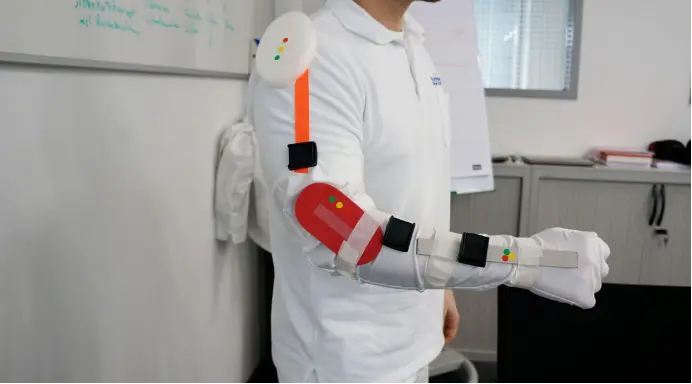
The image shows a prototype of a wearable motion-tracking device worn on the right arm of a person dressed in a long-sleeved white shirt.
Lo-fi prototype of a wearable soft robotic orthosis for communicating needs and requirements during a workshop with users. Note: From “Designing a Wearable Soft-Robotic Orthosis: A Body-Centered Approach” by R. Flechtner, K. Lorenz, and G. Joost, in Proceedings of the Fourteenth International Conference on Tangible, Embedded, and Embodied Interaction (TEI ’20) (p. 867), 2020, Association for Computing Machinery. Image taken from the essay “Deliberately abstract: the tactics of low-fidelity prototyping” by Paula L. Schuster, Rolf Brändle.

Organized into four thematic sections:

  • Imagining the design process,
  • Exploring the design process,
  • Understanding the design process,
  • Developing the design process.
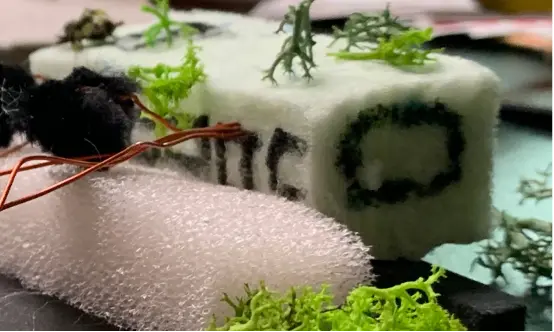
The image shows a close-up detail of an experimental prototype or a conceptual model that combines synthetic materials with organic elements. A block of white spongy material with black markings is visible, topped with tufts of green lichen and moss. Next to the sponge, there are twisted copper wires, a black fibrous material, and another section of translucent synthetic foam. The composition suggests research into bio-hybrid materials or an artistic representation of the interaction between technology and nature.
Prototype showing a slow-bus concept in a speculative city of the future by F. Thomet, outcome of the hybrid participatory workshop The Other City 2 led by J. Tost, P. L. Schuster, R. Flechtner, K. Budinger, and F. Heidmann for PROTOTYP, a design research project at FH Potsdam in 2021. Image taken from the essay “Deliberately abstract: the tactics of low-fidelity prototyping” by Paula L. Schuster, Rolf Brändle

The book brings together interdisciplinary contributions ranging from biodesign to gaming, from virtual reality to assistive technologies, examining low-fidelity prototyping tactics, collaborative learning environments, multisensory translations of materials, data interaction, and the political dimensions of design. What emerges is the situated, relational, and epistemic nature of prototyping and its capacity to generate knowledge. The volume concludes by showing how prototyping goes beyond mere technical validation to take on pedagogical, ecological, and speculative functions, becoming a vehicle for interdisciplinary collaboration, critical reflection, and the negotiation of contemporary design challenges.
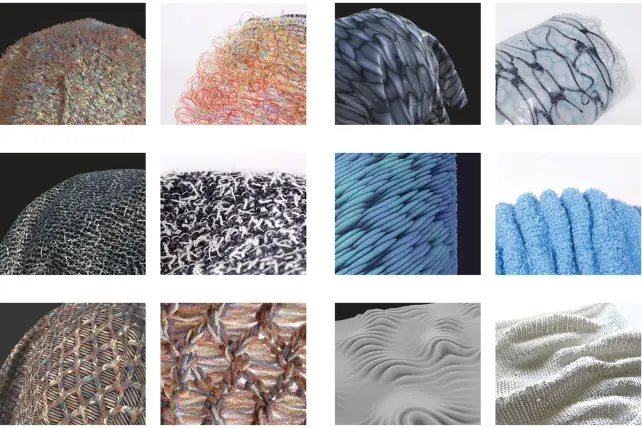
The image is a visual sample board consisting of twelve panels that show different textures and material surfaces, likely the result of experiments in the field of textile design, 3D printing, or bio-digital materials.
Selections from the Feeling Fabrics collection of materials, developed using this methodology. For each material design, both a digital prototype (left) and a physical textile (right) were created, in some cases using a digital-first approach and in other cases a physical-first approach. Image taken from the essay “Experiential substance: tactile translations using digital materials” by Elizabeth Meiklejohn, Felicita Devlin, Caroline Silverman, Dani Epstein, Yue Xu, Joy Ko.

The book is available in the FrancoAngeli open access catalog.

Share on: