Situated Vocabularies

Edited by Virginia Tassinari, Francesca Piredda and Francesco Vergani

Situated Vocabularies. A situated and agonistic conversational platform is a volume that presents a participatory design research project aimed at the co-design of vocabularies of shared meanings, conceived as tools to foster conversations among situated communities and to prompt future-oriented transformative actions. 

The book investigates the power of words as design and political devices, capable of making visible convergences, conflicts, divergences, and nuanced meanings that emerge within complex social contexts, thereby questioning the idea of a neutral and universal language.

Rooted in Hannah Arendt’s definition of democracy and inspired by the vocabulary artifact, the project understands language as an agonistic space of confrontation, negotiation, and collective meaning-making. Its objective is not to impose shared definitions, but to disarticulate and potentially rearticulate different perspectives within a specific context, through collaborative processes involving a plurality of actors and stakeholders. In this sense, Situated Vocabularies takes the form of a conversational platform that makes explicit the interdependencies between subjects, forms of knowledge, and worldviews, while also valuing the tensions and power asymmetries that run through these relationships.
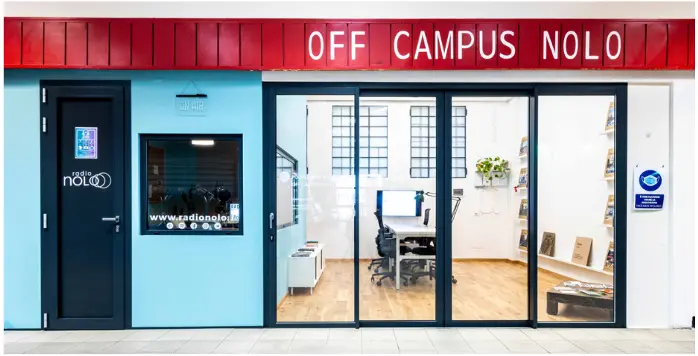
The original space of Off Campus Nolo back in 2020. Image taken from the essay “Off Campus Nolo: Co-producing Knowledge with Situated Communities” by Francesco Vergani.

The experiments presented in the volume are developed within the urban living labs of Off Campus, an initiative of Politecnico di Milano aimed at making the university’s presence in the city more tangible and at strengthening researchers’ responsibility toward contemporary social challenges. Through case studies carried out in the Nolo neighborhood and in San Vittore prison in Milan, the book explores how design for participation can open up to other perspectives and other possible worlds, connecting urban and institutional spaces that are profoundly different yet radically interconnected. In particular, the work conducted in San Vittore highlights the potential of design to create symbolic and communicative bridges between prison and society, questioning the role of design in the translation of meanings, the construction of agency, and the rethinking of the boundaries between inside and outside.

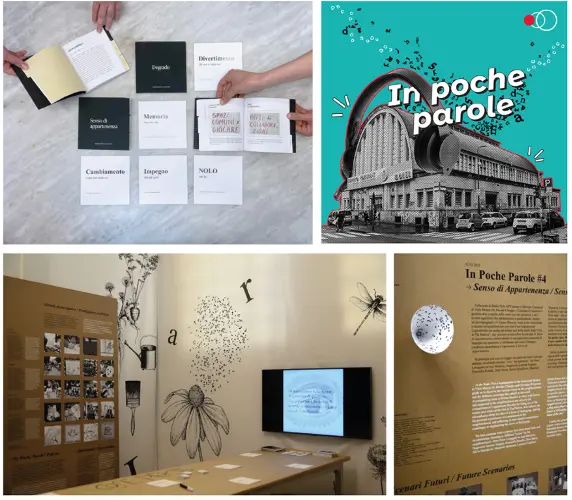
Narrative artifacts of the Nolo Situated Vocabulary: from the top left, the booklets; to the right, the logo of the podcast In Poche Parole; below, details of the exhibition Situated Vocabularies – Re-framing Participation with Fragile Communities at Off Campus Nolo. Image taken from the essay “Narrating Collective Meanings through Tangible Artifacts and Immersive Spatial Experiences” by Ambra Borin.

As a whole, Situated Vocabularies offers a critical reflection on the role of design as a situated, relational, and responsible practice, capable of operating not only through objects and services, but also through words, narratives, and meaning-making tools. The volume addresses designers, researchers, and students interested in participatory design, social research, and change-oriented design practices, providing a theoretical and methodological contribution on how language can become a key lever for imagining and building shared futures.

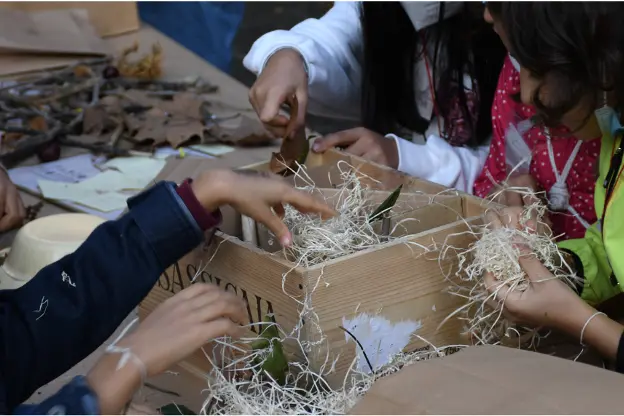
Participants co-constructing the bugs’ hotels. Image taken from the essay “Gaia’s Club: Embodying Situated Vocabulary in Public Spaces through Transmedia Storytelling for Kids” by Valentina Ferreri.
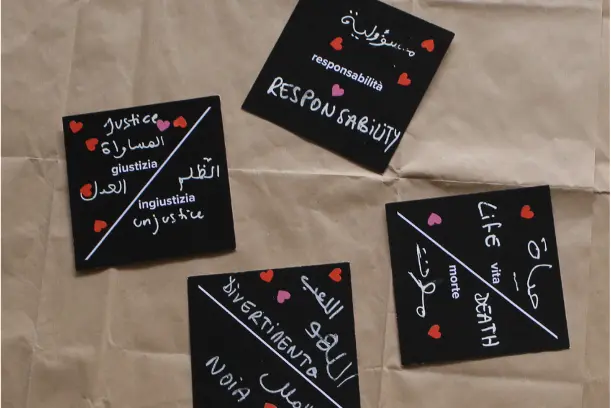
The words selected by the inmates participating in the San Vittore Situated Vocabulary. Image taken from the essay “Off Campus San Vittore: Bridging Prison and Society” by Francesca Piredda.

Share on: