Circular Fashion-Tech Lab
Circular Fashion-Tech Lab
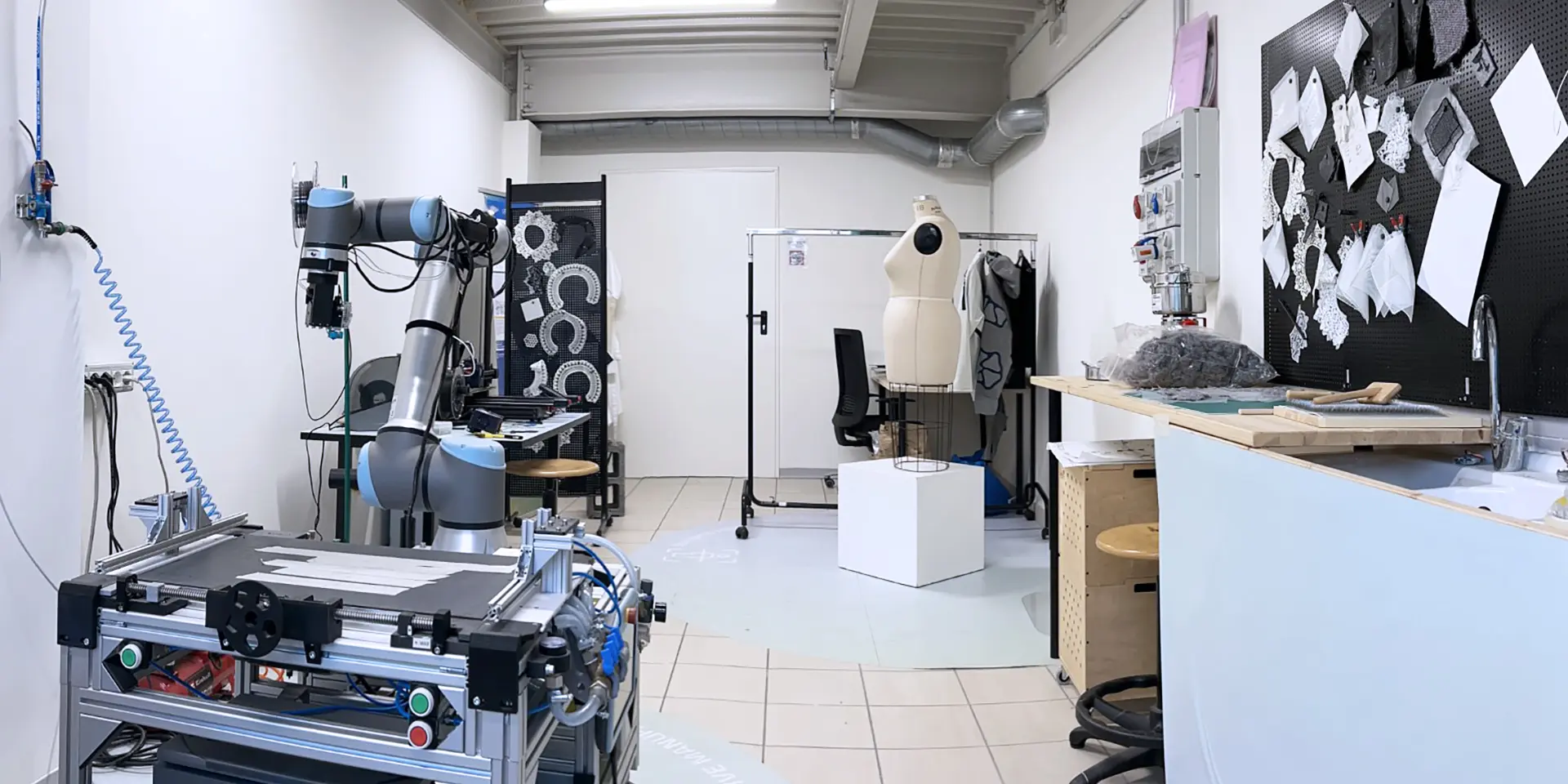
The Circular Fashion-Tech Lab is a research laboratory established to support the fashion sector in the 'twin transition' toward digitalization and sustainability, integrating design with Industry 4.0 and 5.0 technologies. It is conceived as a distributed – both intra-departmental and inter-university – and dynamic research ecosystem, grounded in sharing, with the aim of overcoming technological, organizational, and socio-cultural barriers that slow down the adoption of circular models across the entire fashion supply chain.
Methodology and Equipment
The laboratory adopts a design-driven approach, in which design acts as a strategic driver of innovation along the entire value chain, from product development to end-of-life management. It is equipped with 3D scanning technologies and body digitization systems for anthropometric measurements, 2D and 3D CAD systems for parametric design, desktop 3D printers, and a collaborative robotic arm configured for additive manufacturing and digital drawing on textiles through visual programming protocols. At the same time, it operates as a distributed infrastructure based on inter-institutional collaboration, resource sharing, and co-creation among universities, research centers, and companies.
Research Areas
The laboratory promotes interdisciplinary pilot projects through experimental activities and advanced prototyping, research residencies, and thesis projects. It engages faculty members, researchers, PhD candidates, students, and professionals in a collaborative ecosystem oriented toward innovation in the fashion and creative industries. The current research areas include:
- Digital design and integrated sustainability in tools and design processes
- Digital body and generative design for personalization
- Augmented craftsmanship and non-standard fabrication
- Prototyping and sustainable production using circular materials
Context and Project Network
The laboratory is funded through the Made in Italy Circolare e Sostenibile (MICS) initiative and was launched within the Fashion-Tech Design for Circularity (FasT4C) project. Its activities are developed within an interdisciplinary network involving the Fashion in Process and Materials Design for Transition research groups of the Department of Design at Politecnico di Milano; the Departments of Mechanical Engineering (DMEC) and Management Engineering (DIG) and Chemistry, Materials and Materials Engineering (DCMIC) at Politecnico di Milano; the Department of Developmental and Social Psychology at the University of Padua; and the Department of Environment, Land and Infrastructure Engineering (DIATI) at Politecnico di Torino.
In addition, the lab has established collaborations with Italian companies operating in the fashion-tech sector, working together on research projects aimed at validating body digitization technologies, and as partners of the extended laboratory for experimentation in additive manufacturing using non-standard materials and techniques. At the international level, the lab was presented during EU Design Day 2024 and 2025 in Brussels as an example of a socio-technical infrastructure supporting the digital and sustainable transition of the fashion ecosystem.
Research projects
FasT4C – Fashion-Tech Design for Circularity
Project details
Magazine articles