
Designing Ethically in a Complex World. Multiple challenges within design for public and social systems

Edited by Elena Caratti and Laura Galluzzo

The last image is an abstract graphic background featuring a deep dark purple gradient. The composition continues the series' aesthetic line, showcasing minimalist and blurred overlapping geometric shapes: two ring-like circular forms are visible on the left side, while a stylized radial shape, resembling a gear or a mechanical sun, emerges from the bottom right corner. The design is understated, modern, and elegant, ideal for digital interfaces or professional presentations requiring a technological and refined atmosphere.

The latest addition to the Design International series, Designing Ethically in a Complex World, explores the ethical challenges that arise from applying design to public and social systems.

In an increasingly complex, interconnected and constantly evolving world, this book Designing ethically in a complex world. Multiple challenges within design for public and social systems edited by Elena Caratti and Laura Galluzzo, questions what it truly means to design ethically, and how this can be achieved in practice.

Through theoretical contributions and case studies, the book explores how design can actively transform public and community systems. It focuses on the impact of design in social and public contexts, and on recognising design practices that can truly activate structural and sustainable change.
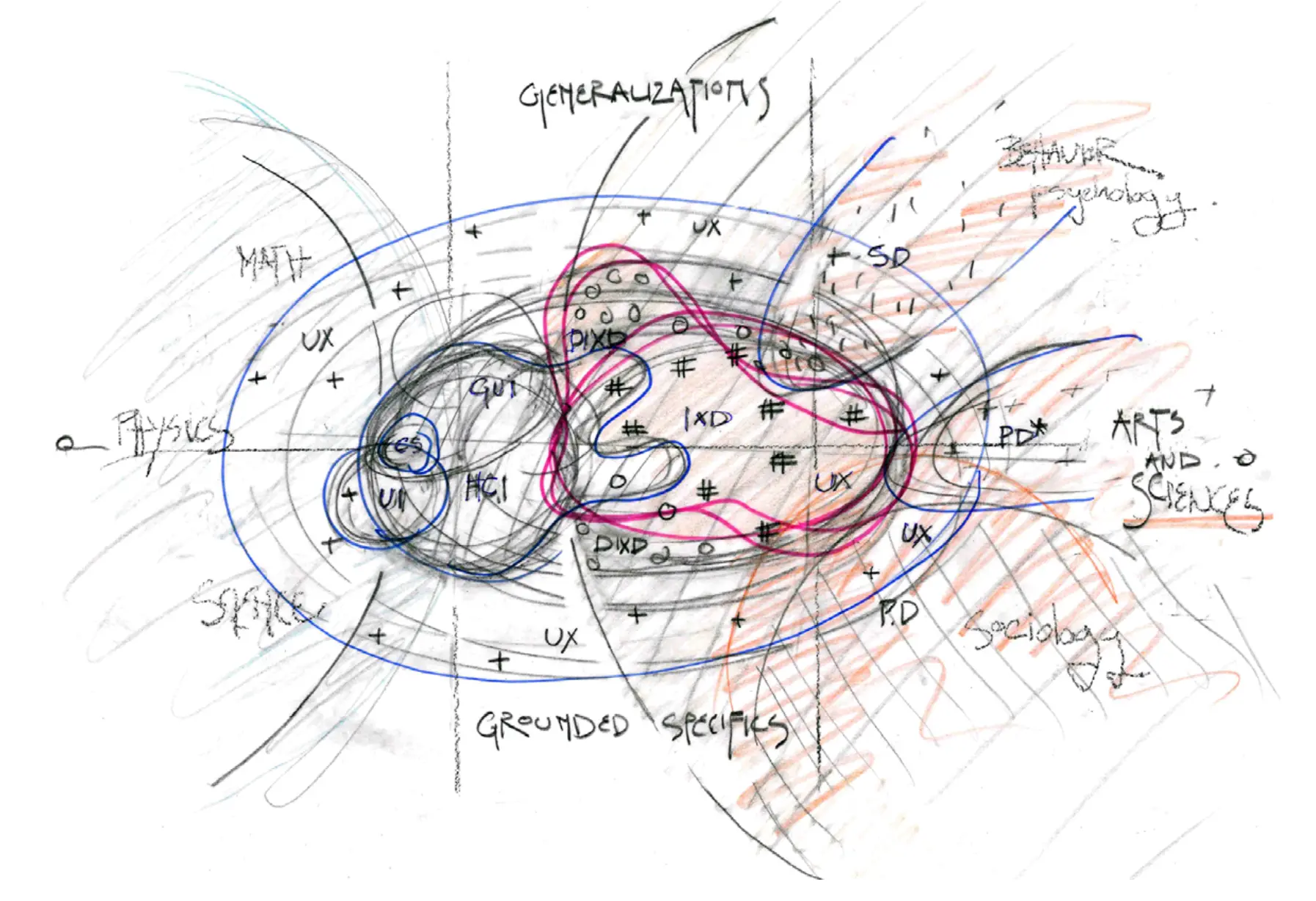
The last image is a hand-drawn conceptual sketch illustrating a complex map of relationships between different disciplines and design areas. Through the use of overlapping Venn diagrams, kinetic lines, and textual annotations, the drawing explores intersections between fields such as math, physics, psychology, and sociology, positioning them along axes ranging from "generalizations" to "grounded specifics." Within these areas are numerous technical acronyms related to user experience and interaction, such as UX, HCI, and GUI, highlighted by splashes of blue, red, and magenta that add visual dynamism to this methodological brainstorming.
Areas of concentration and overlapping relations in Interaction Design. Image taken from the essay 'Ethical dimensions in interaction design' by James Postell.

The volume is divided into two sections:

  • The first section introduces principles, values and theoretical approaches for developing an ethical perspective in design.
  • The second section focuses on practical applications and design practices in public and social contexts, paying particular attention to community engagement, visual identity for children, the design of plural public spaces, and the critical use of digital technologies.

Through a variety of voices and experiences, the book highlights the value of diversity and the importance of being aware of the interdependence between artefacts, individuals, institutions and the environment.

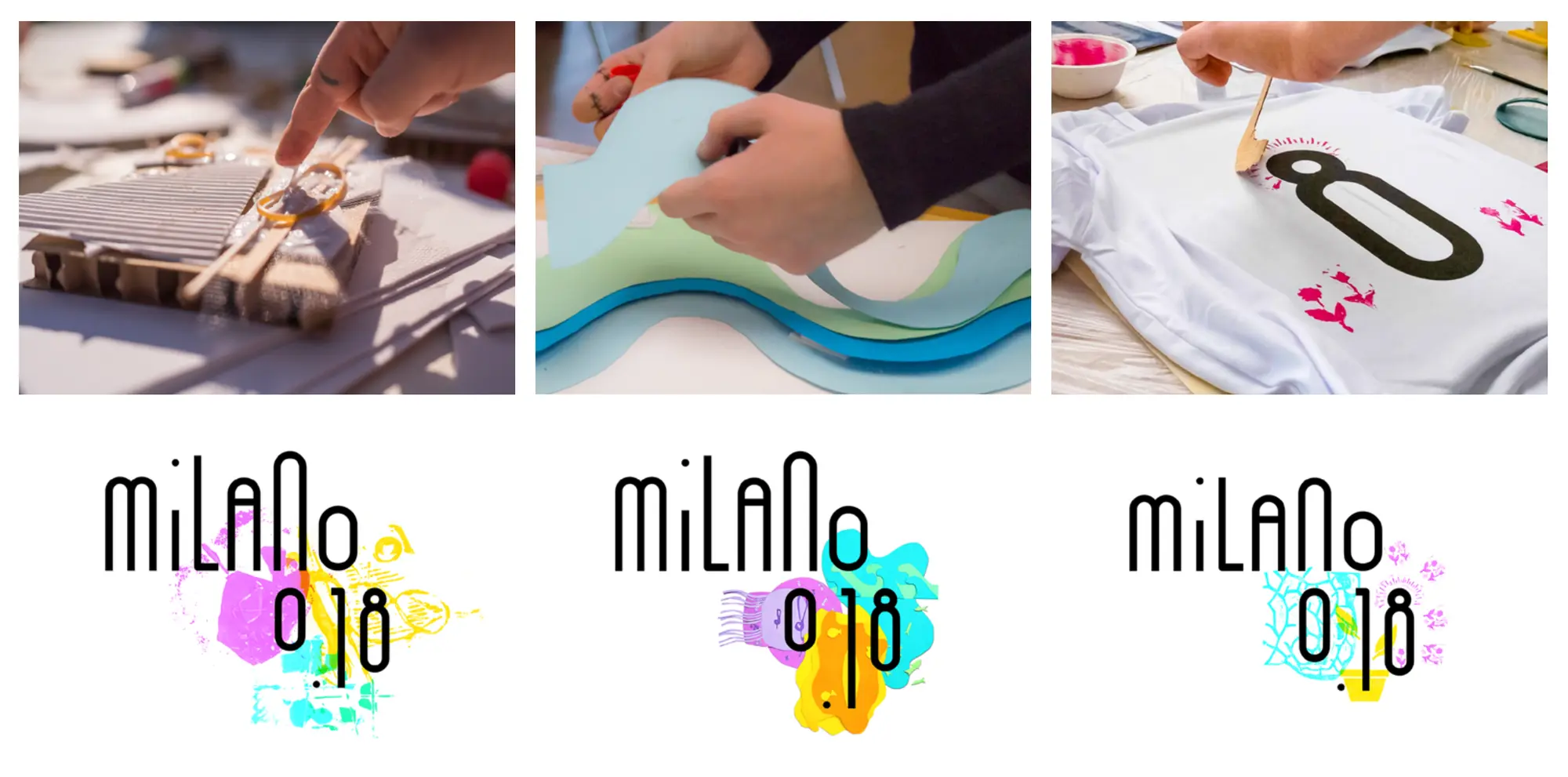
The last image presents a series of three panels illustrating the creative and manual process behind the development of the visual identity for the "Milano 018" project. In the top row, three photographs show stages of a manual workshop: the construction of a textured model using cardboard and rubber bands, the cutting of wavy colored paper shapes, and screen printing on a white t-shirt. In the bottom row, the results of these experiments are translated into three variations of the logo, where the "milano 018" wordmark—featuring a linear and vertical typeface—is enriched by vibrant splashes of color and abstract graphic textures. The collection communicates a design approach that integrates craftsmanship and contemporary graphics to generate a dynamic and multifaceted visual identity.
The artistic techniques explored during the workshops for Milano 0-18 project. Over 3000 new logo configurations can be created by combining the individual contributions from each experience. Image taken from the essay 'Different voices of identity. The role of communication design for the 0-18 community' by Valeria Bucchetti.

Contributions: Anna Anzani, Valeria Bucchetti, Daniela Anna Calabi, Rachele Didero, Davide Fassi, Martina Motta, Adam Nocek, Elettra Panepinto, Francesca Piredda, Ada Piselli, Silvia Pizzocaro, James Postell, Virginia Tassinari, Umberto Tolino, Francesco Vergani, Salvatore Zingale.

Designing Ethically in a Complex World, available in the FrancoAngeli open access catalog , is one of three volumes published as part of the Dipartimenti di Eccellenza – Design for Systemic Change project. The Department of Design launched this series of collective volumes to showcase the cross-disciplinary and collaborative research it conducts, and to present a selection of European research projects that align with the project's objectives.

Share on: